
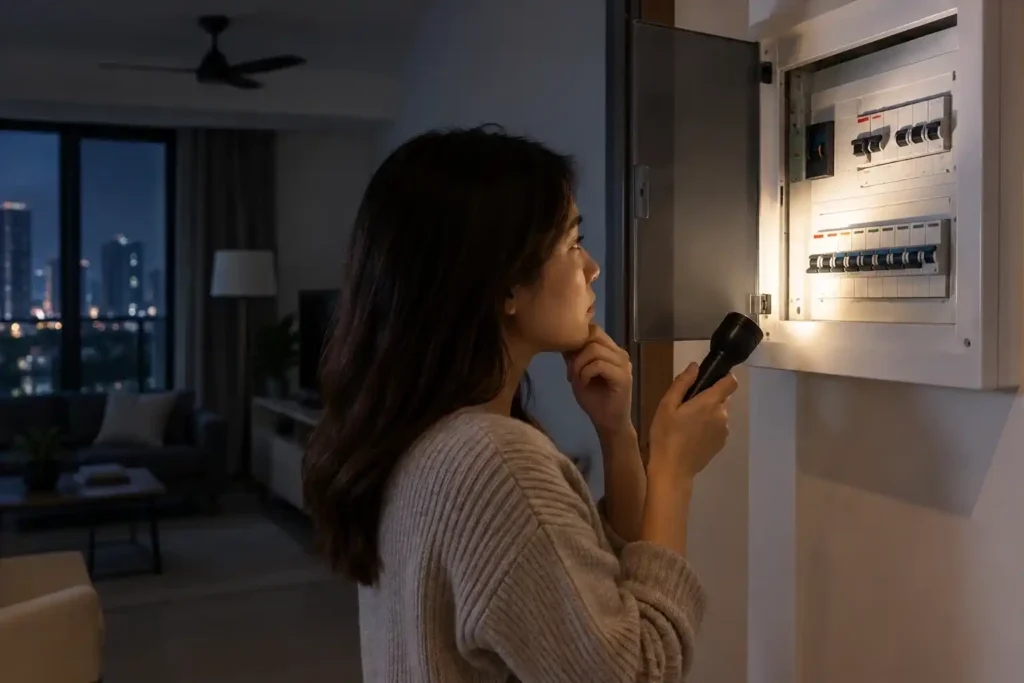
A power trip can happen without warning. One moment, your lights and appliances are working normally. The next, the electricity suddenly cuts off.
While resetting the switch may restore power temporarily, a recurring power trip can indicate an underlying electrical problem that should not be ignored.
In Singapore homes and commercial properties, power trips may be caused by overloaded circuits, faulty appliances, wiring problems, or electrical leakage.
Understanding why the trip happens can help you identify when a simple check is appropriate and when professional electrical repair is needed.
This guide explains the common causes of a power trip, what you can safely check, and when to contact a professional for electrical repair.
What Is a Power Trip?
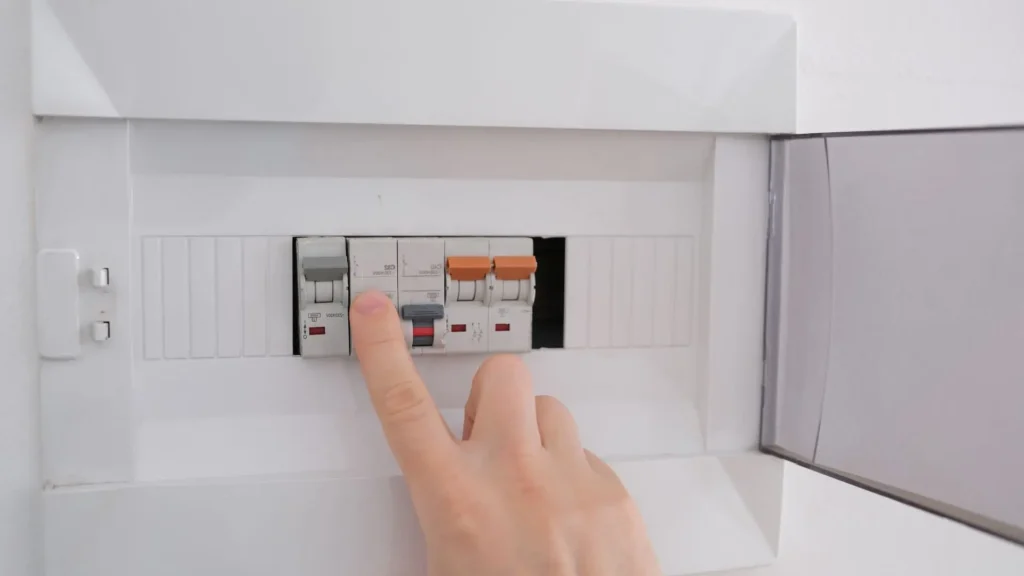
A power trip occurs when an electrical safety device automatically cuts off the electricity supply to protect a circuit or property from a potential electrical hazard.
In Singapore homes, devices such as the Residual Current Circuit Breaker (RCCB) help protect against electric shock by cutting off electricity when current leakage is detected.
According to Singapore’s Energy Market Authority (EMA), current leakage can be associated with faulty appliances, ageing or exposed wires, and damaged insulation.
A power trip is therefore not necessarily a sign that the electricity supply itself has failed. It may be the electrical protection system responding to a problem within your property.
If the power keeps tripping after you restore it, the cause should be investigated rather than repeatedly resetting the breaker.
What Causes a Power Trip?
There are several possible reasons why your electricity may trip. Some are related to the appliances you use, while others may involve the property’s electrical installation.
1. Overloaded Electrical Circuits
One common cause of electrical problems is overloading a power point or circuit with too many appliances.
For example, connecting multiple high-power appliances through extension sockets or adaptors can place excessive demand on a circuit.
It’s better not to overload power points or “piggy-back” multiple plugs into one socket because overheating can create a fire risk.
If your power trips when several appliances are operating at the same time, an overloaded circuit could be one possible explanation.
However, you should not assume that simply using fewer appliances has solved the problem if the trip continues to happen.
2. A Faulty Electrical Appliance
Sometimes, the problem is not with the home’s wiring but with a particular appliance.
A damaged appliance, faulty internal component, or electrical leakage can cause the protective device to trip when the appliance is switched on.
For example, you may notice that the electricity trips shortly after turning on a washing machine, water heater, oven, air conditioner, or another appliance. Faulty appliances can contribute to current leakage and power trips.
If you notice a consistent connection between one appliance and the power trip, stop using the appliance until it can be properly assessed.
3. Damaged or Ageing Electrical Wiring
Electrical wiring can deteriorate over time, particularly in older properties or installations that have experienced wear and tear.
Damaged insulation, exposed wires, loose connections, or other wiring faults can create electrical leakage or short-circuit conditions that cause protective devices to trip.
The difficulty is that most electrical wiring is hidden inside walls, ceilings, conduits, or other parts of the property. This means the underlying problem may not be visible during a normal visual inspection.
If your power trip happens repeatedly without an obvious cause, professional electrical troubleshooting may be necessary.
4. Electrical Leakage
An electrical trip can occur when electricity leaks from its intended path.
This is one of the situations that an RCCB is designed to detect. When the device detects a current imbalance that may indicate leakage, it automatically cuts off the electricity supply.
Electrical leakage can be associated with:
- Faulty appliances
- Damaged insulation
- Ageing or exposed wiring
- Loose electrical connections
- Moisture affecting electrical components
Because electrical leakage can present a safety risk, recurring trips should not simply be treated as an inconvenience.
5. Moisture or Water Exposure
Water and electricity can create serious safety risks.
Moisture can contribute to electrical leakage, particularly around electrical appliances, sockets, wiring, bathrooms, kitchens, balconies, or other areas exposed to water.
Do not to use electrical appliances near water or handle electrical switches with wet hands.
If a power trip occurs after water exposure, do not attempt to investigate electrical components yourself. Keep away from the affected area and arrange for a qualified professional to assess the installation.
6. A Problem With the Circuit Breaker or RCCB
Sometimes the protective device itself may have an issue. The RCCB is an important electrical safety device in Singapore homes.
EMA recommends testing it regularly to make sure it operates correctly. If an RCCB does not trip during its test or repeatedly trips without an obvious cause, homeowners should engage a Licensed Electrical Worker for further checks.
A faulty or problematic breaker should not be replaced or modified as a DIY project.
Also Read: 3 Reasons Your HDB DB Box Tripping Causes Danger (And How to Fix It)
What Should You Do When Your Power Trips?
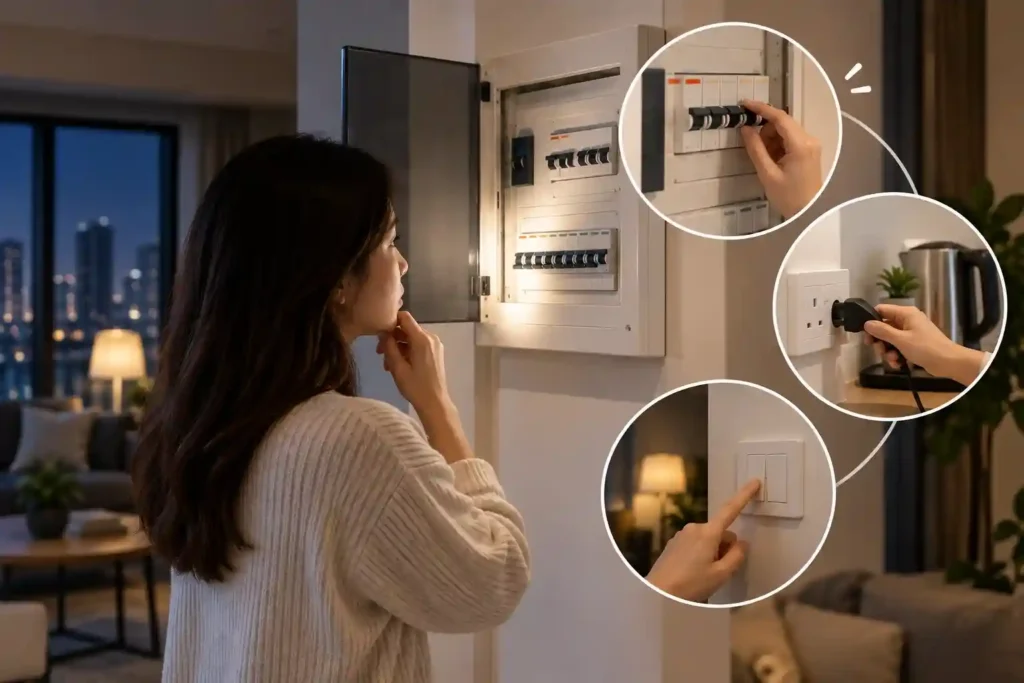
If your electricity suddenly goes off, stay calm and avoid immediately switching everything back on.
Here are some basic steps you can take.
1. Check Whether the Problem Is Only in Your Property
First, check whether your neighbours or common areas also appear to have lost electricity.
If the entire building or surrounding area is affected, the issue may be a wider electricity supply disruption rather than a local electrical fault.
If only your property has lost power, check your distribution board for a tripped circuit breaker or RCCB.
This distinction can help you understand whether you are dealing with a wider power outage or a local power trip.
2. Switch Off or Unplug Appliances If It Is Safe to Do So
If you suspect that a particular appliance may have caused the trip, switch it off and unplug it only if it is safe to access.
Do not touch electrical equipment with wet hands or if the surrounding area is wet.
If there are signs of burning, smoke, sparks, exposed wires, or a burning smell, keep away from the affected equipment and seek professional assistance.
3. Check the Distribution Board
Your home’s distribution board, commonly known as the DB box, contains electrical protection devices.
An RCCB can generally be identified by its Test button. It is designed to cut off electricity when it detects current leakage.
If you are unfamiliar with the switches in your distribution board, avoid experimenting with them. Electrical troubleshooting and repairs should be handled by an appropriately licensed electrical professional.
4. Do Not Keep Resetting a Tripped Breaker
A breaker that trips once may have responded to a temporary condition. However, repeated power trips are a warning sign.
If the electricity trips again shortly after being restored, repeatedly resetting the breaker without identifying the cause does not address the underlying issue.
If you frequently experience power trips, it’s better to engage a Licensed Electrical Worker to carry out the necessary checks.
Power Trip vs Power Outage: What’s the Difference?
Although the terms are sometimes used interchangeably, a power trip and a power outage can describe different situations.
| Power Trip | Power Outage |
| Often relates to an electrical protection device cutting power | Generally refers to an interruption of electricity supply |
| May affect only one property or circuit | Can affect multiple properties or a wider area |
| Can be triggered by electrical faults, leakage or overloaded circuits | Can result from problems affecting the wider electricity network |
| May continue happening if the underlying fault remains | Usually depends on restoration of the external electricity supply |
For example, if your neighbours still have electricity but your home’s RCCB has tripped, you may be dealing with a local electrical issue.
If multiple surrounding properties have lost electricity at the same time, the situation may instead be a wider power outage.
Get Professional Help from SHS Handyman Singapore
A sudden power trip can be inconvenient, but repeated electrical trips should not be ignored.
The cause could be as simple as an overloaded circuit or faulty appliance, or it could indicate a deeper issue involving wiring, electrical leakage, or the property’s electrical installation.
If you are experiencing recurring electrical problems, SHS Engineering provides professional electrical repair services in Singapore to help address electrical issues in homes and properties.
Rather than repeatedly resetting a tripped breaker, arrange for the problem to be properly assessed so the underlying cause can be identified and addressed.
Need help with an electrical issue? Contact SHS Engineering or send us a message (Whatsapp) to discuss your electrical repair requirements.
Frequently Asked Questions About Power Trips
Why does my power keep tripping?
A power trip can be caused by an overloaded circuit, faulty appliance, electrical leakage, damaged wiring, moisture, or an issue with a protective device such as an RCCB. If the problem keeps occurring, professional electrical inspection is recommended.
Is a power trip dangerous?
A power trip is often the result of a protective device responding to a potential electrical problem. The trip itself can be an important safety function, but frequent or unexplained trips should not be ignored, as they may indicate an underlying electrical fault.
What is the difference between a power trip and a blackout?
A power trip generally refers to electricity being cut off by a protective device in response to an electrical condition, while a blackout or wider power outage refers to an interruption affecting the electricity supply. A local power trip may affect only one property or circuit.
Can I keep resetting my power breaker?
If the breaker trips repeatedly, you should not simply keep resetting it. Repeated tripping can indicate an underlying electrical problem that needs to be investigated by a qualified professional.
How do I know if my RCCB is working?
EMA provides a three-step RCCB test involving the Test button, checking whether lights and sockets remain off when the RCCB is tripped, and restoring the switch afterward. If the RCCB does not trip during testing or some circuits remain powered when they should not, contact a Licensed Electrical Worker.
When should I call an electrician for a power trip?
Contact an appropriately licensed electrical professional if the power keeps tripping, the cause is unclear, there are signs of damaged wiring or burning, an appliance repeatedly causes a trip, or you have concerns about the condition of your electrical installation.