

Choosing the right false ceiling material is an important part of planning a ceiling for your home, office, or commercial space. The material affects not only how the finished ceiling looks, but also its durability, moisture resistance, maintenance requirements, installation process, and suitability for the room.
In Singapore, where humidity is an important consideration, choosing a ceiling material based purely on appearance or price may not be enough.
A material that works well in a dry living room may not necessarily be the most suitable choice for a bathroom, kitchen, or other area exposed to moisture.
So, what are the different false ceiling materials, and which is the best material for ceiling installation?
From gypsum board and plasterboard to PVC, metal, mineral fibre, and cement board, each option has its own characteristics.
This guide explains the main types of ceiling materials, where they are commonly used, and what to consider before choosing one for your project in Singapore.
What Is a False Ceiling?
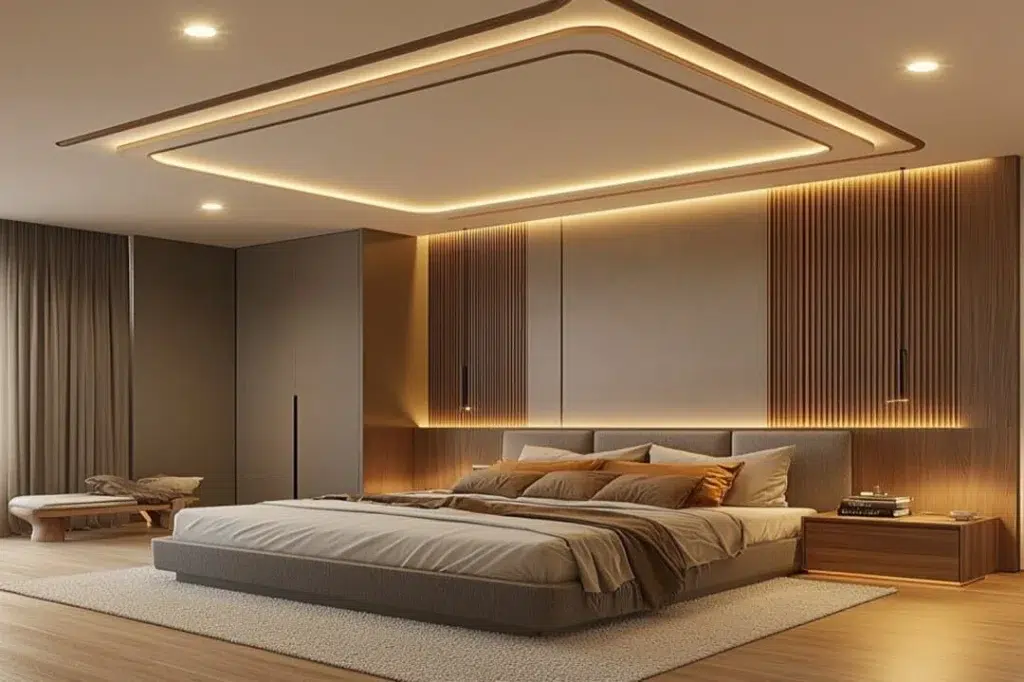
A false ceiling, also known as a dropped or suspended ceiling, is a secondary ceiling installed below the original structural ceiling.
It creates a space between the original ceiling and the new ceiling surface. This space can be used to accommodate electrical wiring, lighting, air-conditioning components, pipes, and other building services.
False ceilings can also be used to improve the overall appearance of an interior. For example, a plain ceiling can be transformed with recessed lighting, different ceiling levels, concealed lighting, or other architectural details.
Common reasons for installing a false ceiling include:
- Concealing electrical wiring and services
- Installing recessed or concealed lighting
- Creating a more polished interior appearance
- Creating different ceiling levels
- Accommodating air-conditioning components
- Improving the visual proportions of a room
- Creating decorative ceiling features
The material of false ceiling construction is an important consideration because different materials perform differently depending on the environment and intended use.
Types of False Ceiling Materials
There is no single material that works best for every false ceiling project. The right option depends on the location, moisture exposure, desired appearance, maintenance requirements, budget, and functional needs of the space.
Below are some of the most common false ceiling materials to consider.
1. Gypsum Board

Gypsum board is one of the most widely used materials for interior false ceilings. It consists of a gypsum core enclosed between layers of facing material and is installed onto a supporting framework.
One of its main advantages is the smooth surface it can provide after the joints have been properly treated and finished. This makes gypsum board particularly suitable when you want a clean, seamless-looking ceiling that can be painted to match the interior.
Gypsum board also offers considerable design flexibility. It can be used to create simple flat ceilings as well as recessed sections, stepped ceilings, lighting coves, and other decorative features.
Benefits of gypsum board
- Smooth, seamless appearance after finishing
- Can be painted in almost any colour
- Flexible for different ceiling designs
- Suitable for recessed and concealed lighting
- Can accommodate different ceiling levels
- Available in different specifications for specific applications
Where is gypsum board suitable?
Gypsum board is commonly considered for:
- Living rooms
- Bedrooms
- Dining areas
- Offices
- Retail interiors
- Meeting rooms
- Other relatively dry indoor spaces
However, standard gypsum board should not automatically be considered waterproof. If the ceiling will be exposed to moisture or humidity, the appropriate moisture-resistant board or another suitable ceiling system should be selected.
2. Plasterboard

Plasterboard is another commonly used term when discussing interior ceiling and wall boards. In many markets, plasterboard refers to a gypsum-based board consisting of a gypsum core with a paper or other facing.
Because of this, gypsum board and plasterboard are often not two completely different materials. The terminology can vary depending on the manufacturer, country, and construction industry.
What matters more when choosing a plasterboard product is its specific specification. Different boards can be designed for different requirements, including standard interior applications, moisture resistance, fire performance, or improved acoustic performance.
Benefits of plasterboard
- Smooth finish
- Suitable for painting
- Relatively lightweight compared with some traditional ceiling materials
- Flexible for interior ceiling designs
- Available in different specifications
- Suitable for integration with lighting
Where is plasterboard suitable?
Depending on the product specification, plasterboard can be used for:
- Residential ceilings
- Bedrooms
- Living rooms
- Offices
- Commercial interiors
- Interior wall and ceiling systems
When comparing Gypsum vs Plasterboard, it is therefore important to check the actual product specifications instead of assuming that one category is always stronger, more fire-resistant, or more moisture-resistant than the other.
3. PVC Ceiling Panels

PVC, or polyvinyl chloride, is another popular option when considering false ceiling material.
This panels are manufactured in different colours, patterns, textures, and finishes, making them suitable for projects where easy maintenance and moisture resistance are important.
One of the main advantages of PVC is its resistance to moisture. Unlike conventional paper-faced gypsum boards, PVC does not absorb water in the same way, making it worth considering for areas with higher humidity or occasional moisture exposure.
PVC panels are also relatively easy to clean. This can be useful in areas where dust, condensation, or splashes may make regular maintenance necessary.
Benefits of PVC ceiling
- Good moisture resistance
- Easy to wipe and clean
- Low maintenance
- Lightweight
- Available in various colours and patterns
- Relatively straightforward to install
Where is PVC suitable?
PVC ceilings can be considered for:
- Bathrooms
- Kitchens
- Utility areas
- Service areas
- Humid environments
- Certain residential and commercial interiors
However, PVC has a different appearance from a painted gypsum ceiling. If your priority is a seamless, architectural finish with integrated lighting and multiple levels, gypsum or plasterboard may offer greater design flexibility.
4. Metal Ceiling Panels
Metal is another option for ceiling materials, particularly in commercial and modern architectural environments.
This ceiling systems may use materials such as aluminium or steel and can come in panels, strips, tiles, or other modular formats. Depending on the system, individual panels can sometimes be removed to provide access to the services located above the ceiling.
Metal ceilings are generally durable and can create a contemporary appearance. They can also be useful in environments where a more robust ceiling surface is required.
Benefits of metal ceilings
- Durable
- Resistant to impact compared with some lightweight board systems
- Available in modern finishes
- Can provide access to services in modular systems
- Suitable for commercial applications
- Can be used for decorative architectural designs
Where are metal ceilings suitable?
They may be suitable for:
- Offices
- Retail spaces
- Commercial buildings
- Corridors
- Restaurants
- Modern industrial interiors
- Areas requiring a more durable ceiling system
The appearance and acoustic characteristics depend heavily on the specific metal ceiling system selected.
5. Mineral Fibre Ceiling Tiles
Mineral fibre is commonly used in suspended ceiling systems, particularly in commercial environments.
Unlike a seamless gypsum ceiling, mineral fibre ceilings are generally made up of individual tiles installed within a visible or concealed grid system. This makes them particularly practical where regular access to wiring, air-conditioning systems, and other services above the ceiling is required.
Another important advantage is acoustic performance. Certain mineral fibre ceiling tiles are designed to help absorb sound, making them useful in offices and other spaces where controlling noise is important.
Benefits of mineral fibre ceilings
- Good acoustic performance in suitable products
- Individual tiles can be removed for maintenance
- Convenient access to services above the ceiling
- Available in different textures and patterns
- Suitable for commercial environments
Where are mineral fibre ceilings suitable?
They are commonly considered for:
- Offices
- Meeting rooms
- Schools
- Commercial spaces
- Healthcare environments
- Other spaces where acoustic control and service access are important
However, they provide a different aesthetic from a smooth plasterboard or gypsum ceiling and may not be the preferred option for residential interiors where a seamless appearance is desired.
6. Cement Board
Cement board is another type of board material that can be used for selected ceiling applications where greater resistance to moisture or impact is required.
Compared with standard gypsum board, cement board is generally denser and more robust. However, this also means it can be heavier and more difficult to handle and install.
Cement board is therefore usually selected based on the specific requirements of the project rather than simply because it is stronger.
Benefits of cement board
- More resistant to moisture than standard paper-faced boards
- Durable
- Good impact resistance
- Suitable for demanding applications
- Can be used where greater board durability is required
Where is cement board suitable?
Depending on the system and manufacturer’s specifications, cement board may be considered for:
- Areas with higher moisture exposure
- Utility spaces
- Certain external or semi-exposed applications
- Areas requiring greater impact resistance
The appropriate product should always be selected based on the installation environment and manufacturer’s recommendations.
How to Choose the Right False Ceiling Material
With so many types of ceiling materials available, choosing between them can be difficult. Instead of asking which material is universally the best, consider what your particular room requires.
1. Consider Where the Ceiling Will Be Installed
The room’s environment should be one of the first things you consider.
A bedroom has very different requirements from a bathroom. Similarly, an office may prioritise acoustic performance and access to concealed services, while a living room may place greater emphasis on appearance and lighting design.
For a typical dry residential room, gypsum or plasterboard may be suitable. For areas with greater moisture exposure, PVC or an appropriately specified moisture-resistant board may be worth considering.
2. Consider Moisture and Humidity
Moisture is particularly relevant when choosing ceiling materials in Singapore.
Bathrooms, kitchens, utility rooms, and areas near water sources may experience more humidity or occasional splashes than bedrooms or living rooms.
This does not mean that every humid room automatically needs PVC. The appropriate solution depends on the degree of moisture exposure and the specifications of the material and ceiling system.
3. Think About the Finished Appearance
The appearance of the finished ceiling can significantly influence your choice of false ceiling material.
Gypsum and plasterboard can provide a smooth surface that can be painted, making them suitable for contemporary interiors and architectural ceiling designs.
PVC provides a panel-based appearance, while metal can create a more modern commercial look. Mineral fibre tiles, meanwhile, are often chosen for their practical and acoustic properties rather than for a seamless decorative appearance.
4. Consider Lighting and Concealed Services
Think about what you need to be install above or within the ceiling.
A false ceiling may need to accommodate:
- Recessed lighting
- LED strips
- Electrical wiring
- Air-conditioning components
- Pipes
- Access panels
- Other building services
Gypsum and plasterboard systems can provide considerable flexibility for integrating lighting and creating different ceiling levels. Modular systems such as metal or mineral fibre ceilings can offer easier access to services above the ceiling.
5. Consider Maintenance Requirements
Different materials require different types of maintenance.
PVC is relatively easy to wipe clean, while a painted gypsum or plasterboard ceiling may eventually require repainting or patching if the surface becomes damaged.
For commercial spaces where technicians need frequent access to services above the ceiling, a modular ceiling system may be more practical than a fully seamless ceiling.
Think about how the room will actually be used before deciding which material to install.
6. Consider Fire and Acoustic Requirements
The performance of a ceiling should not be judged by appearance alone.
Some ceiling products are specifically manufactured with enhanced fire or acoustic properties. These characteristics can vary considerably between products, even when they appear similar.
If fire resistance or acoustic control is important for your project, check the specifications and certifications of the particular ceiling system rather than assuming that all gypsum, plasterboard, PVC, or mineral fibre products perform identically.
False Ceiling Material Comparison
The following gives you a quick overview of the main materials discussed above:
| Material | Appearance | Moisture Resistance | Design Flexibility | Maintenance | Common Applications |
|---|---|---|---|---|---|
| Gypsum board | Smooth, seamless | Depends on specification | High | Moderate | Homes, offices, commercial interiors |
| Plasterboard | Smooth, seamless | Depends on specification | High | Moderate | Homes, offices, commercial interiors |
| PVC | Panelled | High | Moderate | Easy | Bathrooms, kitchens, utility areas |
| Metal | Modern / modular | Generally good | Moderate–High | Moderate | Offices, retail, commercial spaces |
| Mineral fibre | Tile/grid appearance | Depends on product | Moderate | Easy access for maintenance | Offices, commercial spaces |
| Cement board | Board-based finish | High depending on product | Moderate | Moderate | Moisture-prone or demanding applications |
This table is a starting point rather than a substitute for product specifications. The performance of a particular ceiling can vary depending on the manufacturer, board type, thickness, framing system, installation method, and surrounding environment.
Plasterboard vs PVC: Which Is Better?
Once you understand the different false ceiling materials, it becomes easier to compare specific options.
Plasterboard vs PVC is a common comparison because you can use both for ceiling applications, but they are designed around different priorities.
Choose plasterboard when you want:
- A smooth, seamless ceiling
- A painted finish
- Greater flexibility for decorative ceiling designs
- Recessed or concealed lighting
- A conventional residential or office ceiling appearance
Choose PVC when you prioritise:
- Moisture resistance
- Easy cleaning
- Low maintenance
- A panel-based ceiling finish
- Certain humid or moisture-prone applications
So, which is better?
There is no universal winner. For a dry living room where aesthetics and ceiling design are the main priorities, plasterboard may be more suitable. For a bathroom or another area where moisture resistance and easy cleaning are more important, PVC may be a more practical option.
The environment, design requirements, and specifications of the particular products should ultimately determine the choice.
Gypsum vs Plasterboard: What Should You Know?
If you have searched for “Gypsum vs Plasterboard” or “plasterboard vs gypsum board”, you may have noticed that different websites describe them as separate materials.
In many cases, this is mainly a terminology difference. Both terms commonly refer to gypsum-based boards used for interior walls and ceilings.
Instead of focusing only on the name, check the specific product’s:
- Thickness
- Moisture resistance
- Fire performance
- Acoustic properties
- Manufacturer specifications
- Intended application
This is a more useful way to compare products than assuming that every gypsum board and plasterboard product has identical performance.
What Is the Best Material for a False Ceiling?
The best material for ceiling installation depends on the room and what you want the ceiling to achieve.
- For living rooms and bedrooms:
Gypsum or plasterboard can be a good option when you want a smooth, painted finish and flexibility for lighting or decorative designs. - For bathrooms and moisture-prone areas:
PVC or an appropriately specified moisture-resistant ceiling system may be more suitable, depending on the conditions. - For offices:
Gypsum, plasterboard, mineral fibre, or metal systems can all be considered depending on appearance, acoustics, maintenance, and access requirements. - For commercial spaces:
Metal and mineral fibre systems can be useful where durability, modular access, or acoustic performance is important, while gypsum can provide a more seamless architectural finish.
Rather than choosing based on a generic ranking of materials, consider the environment, appearance, maintenance, performance requirements, and budget together.
Get Professional False Ceiling Services in Singapore
Choosing the right false ceiling material is only the first step. The supporting framework, installation, joint finishing, lighting integration, and overall workmanship can all affect how the finished ceiling looks and performs.
If you’re planning a new false ceiling or replacing an existing one, SHS Handyman provides professional ceiling and partition services in Singapore for residential and commercial spaces. The team can help you determine a suitable ceiling solution based on your property’s requirements and install the chosen system with the appropriate finishing.
Contact SHS Handyman today to discuss your false ceiling project and get professional assistance with your ceiling material and installation needs.